Our Work
Preparation of a National Policy Directive for Management of Human-Wildlife Conflict (HWC) in Sri Lanka
The PSSL has carried out several national level activities and projects in keeping with the objectives of the Society. One was a widely consultative activity in 2018, with national, regional and local ramifications to prepare Policy Directives for Managing the Human-Wildlife Conflict in Sri Lanka, on behalf of the Department of Wildlife Conservation.
This was meant to serve as an umbrella policy for specific plans focusing on species groups such as elephants, monkeys, leopards, etc. This widely consultative plan, which included numerous consultations with experts on elephants, leopards, and other wildlife; district level administrators; staff of the Department of Wildlife Conservation, Forest Department, and other state stakeholders, as well as affected community members, does not recommend ad hoc translocation of problem animals, and cautions against uninformed decisions. The document cites well researched references to human-monkey conflict in other countries and presents a detailed analysis of all relevant national laws that relate to this issue.
As the Policy Directives have not yet received Cabinet approval—partly due to delays caused by the COVID-19 pandemic and subsequent economic disruptions in October 2023, PSSL representatives met with the Department of Wildlife Conservation and the Ministry of Wildlife and Forest Resources Conservation to offer any support needed to advance the Directives as a Cabinet-approved policy. However, follow-up action was delayed again due to changes in the Ministry.
In 2025, three PSSL members were invited by the Presidential Secretariat to participate in expert-level discussions on Human–Wildlife Conflict, with particular emphasis on crop raiding. At this meeting, Dr Jinie Dela reiterated the importance of securing Cabinet approval for the Policy Directives and shared soft copies with the convenors. Nevertheless, there is strong concern that the absence of a comprehensive stocktake of previous work, will lead to unnecessary duplication of past efforts, which can even be destructive.

Challenges and the Road Ahead
Despite steady progress, primate conservation in Sri Lanka faces continuing challenges limited funding, demanding field conditions, and too few young scientists entering this rigorous and hard but vital field. Sustaining and expanding this work depends on collaboration, shared commitment, and new partnerships grounded in science and integrity.
Assisting Nature based Tourism in Sri Lanka
Addressing Human-Monkey Conflict
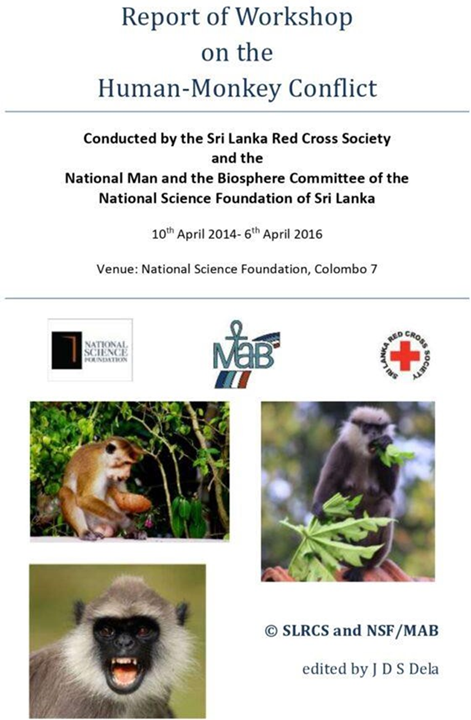
This matter has long been the focus of attention by primatologists and other scientists in the country. In 2014, The National Man and the Biosphere Committee (hosted then by the National Science Foundation) prepared a comprehensive framework for action to specifically address the problems faced by people and farmers from monkeys in this country. This effort had the support and participation of all field primatologists (PSSL members) in Sri Lanka at the time, all relevant state agencies, NGOs working on primates, and the representatives of district level administrators and affected communities. The recommendations were updated in 2016 and 2017. Dr Jinie Dela (President of the PSSL) was the advisor for this process and prepared the reports on a voluntary basis. The plan was presented to the then Ministry of Science and Technology in 2017 and received a very positive response, but due to administrative changes in the Ministry of wildlife and Forest Resources conservation, action was stalled.
Due to the concerns that arose in the country regarding proposals for large scale export of the endemic toque macaque to alleviate Human-monkey conflict, in October 2023 the PSSL met with the Department of Wildlife Conservation and officials of the Ministry of Wildlife and Forest Resources Conservation to initiate actions that were recommended in the above reports. The response was positive, and the PSSL agreed to provide all support to the MoW&FRC to address this contentious issue. Changes in the Ministry prevented follow-up action. In response to the attempts made for a primate census and other unsatisfactory concerns.
In October 2025, three members of the Primate Society of Sri Lanka were invited by the Presidential Secretariat to participate in expert-level discussions on Human–Wildlife Conflict, with particular focus on crop raiding. Dr Jinie Dela highlighted the work already done and shared soft copies of the Report on human-monkey conflict prepared with the leadership of PSSL members with the convenors of the meeting. However, there is concern that a comprehensive stocktake of previous work has not yet been undertaken, which could lead to unnecessary duplication of past efforts to address the human–monkey conflict.
It is expected that follow-up action on the earlier work of the National MAB Committee on this issue, archived with full support of PSSL members, will be facilitated by the current MAB Committee (2025), now hosted by the Sri Lanka National Commission for UNESCO.
Our focus
As a professional society, the PSSL exists to advance primatology and primate conservation in Sri Lanka supporting and empowering the professionals and field teams who dedicate their lives to understanding and safeguarding the island’s primates. We bring together researchers and practitioners, foster collaboration, uphold ethical standards, and promote conservation grounded in science. As Sri Lanka’s national platform for primatology, the PSSL strengthens the work of those in the field while guiding and inspiring the next generation of primatologists.
As a professional society, the PSSL exists to support the people behind primate conservation in Sri Lanka — the professionals and their field teams who dedicate their lives to understanding and protecting the island’s primates. We provide a platform for these individuals to advance their work and to assist and encourage students of primatology in the country.
Our purpose is to turn individual effort into collective impact. We promote our members and the long-term research and conservation initiatives they lead, strengthening their contributions through collaboration, shared expertise, and credible scientific input to national processes such as policy development, Red List assessments, and management planning. While the Society itself does not operate directly at the grassroots level, our members are active in the field across Sri Lanka, and we draw on their collective strengths — and our wider networks — to address key issues affecting primate conservation island-wide.
The PSSL aspires to serve as a professional forum and technical reference point for evidence-based dialogue on primates and their conservation, creating opportunities for collaboration and exchange as the Society grows. Through this platform, we also aim to connect professionals and the wider public with accurate, science-based information on primates and the issues that shape their future.
We also aim to build a network of people with a genuine and enduring interest in primates who wish to take an active part in primate conservation in meaningful ways — whether by managing their lands as safe spaces for primates, guided by sound ecological advice, or by supporting long-term field initiatives led by our members. Through shared learning and practical collaboration, we seek to connect these supporters with the science, fieldwork, and passion that continue to drive primate conservation forward in Sri Lanka.